CFD Modeling & Energy Systems Research
Now Recruiting: Undergraduate & Graduate Research Opportunities Led by Dr. Zhaouri Li
Computational Fluid Dynamics (CFD) leverages high-performance computing (HPC), artificial intelligence (AI), machine learning (ML), and GPU acceleration to investigate complex fluid flows in advanced energy systems
Dr. Li’s student research addresses challenges across:
- Advanced propulsion systems
- Renewable energy technologies
- Fusion energy
- Multiphase combustion
- Offshore wind and marine atmospheric systems
This work combines high-fidelity numerical simulations with modern computational methods to improve performance, efficiency, and stability in next-generation energy systems.
Research Areas
Plasma Instabilities & Fusion Energy
High-order two-fluid plasma solvers are used to investigate plasma turbulence and magnetized Rayleigh–Taylor instabilities (MRTI) during inertial confinement fusion (ICF) deceleration stages
Shock–Turbulence–Combustion Interactions
Direct Numerical Simulation (DNS) is applied to study shock-turbulence-combustion interactions in:
- Supersonic combustion ramjets
- Advanced blast chambers
High-order Monotonicity-Preserving schemes enable accurate shock capture without numerical oscillations
Multiphase & Multicomponent Flow Modeling
Advanced CFD methodologies investigate:
- Spray combustion in dump combustors and swirl burners
- Turbulence-droplet-combustion coupling
- Interface dynamics using Cahn-Hilliard Navier–Stokes equations
Hybrid LES-FMDF models resolve complex multiphase interactions
Variable Property Turbulent Flows
Numerical studies address turbulent flows with large variations in:
- Viscosity
- Mass diffusion
- Heat conduction
Applications include astrophysics, fusion systems, and biological transport processes
Wind–Wave Interaction & Offshore Energy
Research investigates multi-scale, multi-physics wind–wave interactions in the Marine Atmospheric Boundary Layer (MABL)
This work improves understanding of:
- Offshore wind turbine performance
- Wave boundary layer dynamics
- Energy extraction efficiency
High-Fidelity Simulation Examples
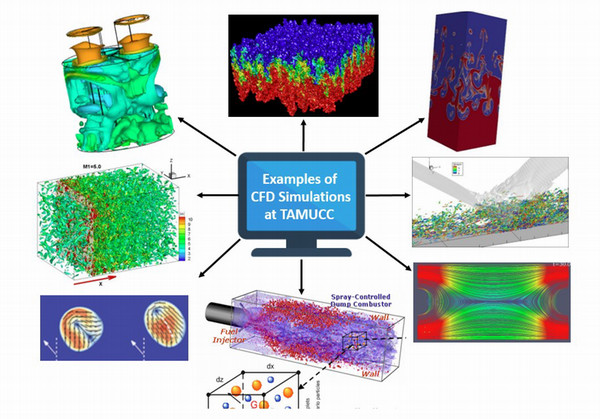
Examples of CFD simulations conducted at TAMU-CC include high-resolution turbulence fields, plasma instability modeling, combustion spray simulations, and wind–wave boundary layer interactions
Research Activites May Include
- High-order CFD solver development
- GPU-accelerated simulation workflows
- AI/ML-enhanced turbulence modeling
- Plasma and fusion modeling
- Multiphase combustion simulations
- Offshore wind flow analysis
For more information please reach out to Dr. Zhaouri Li.