Exploring AI Together


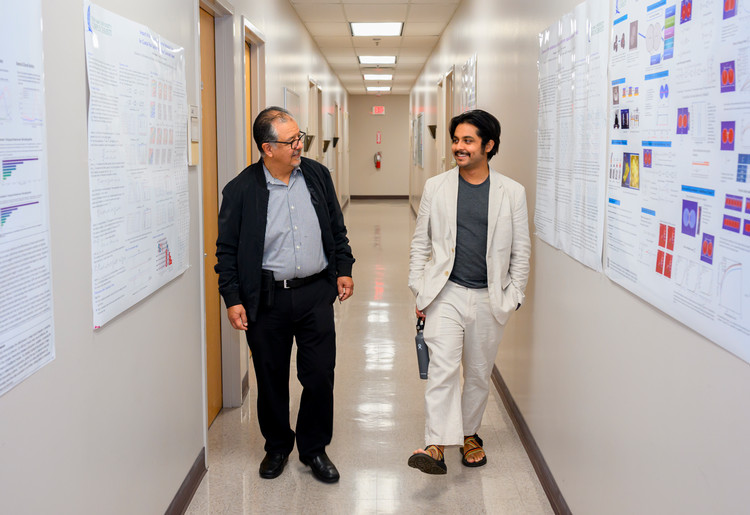
CORPUS CHRISTI, Texas – As artificial intelligence accelerates into higher education, Dr. Chris Benedetti didn’t want Texas A&M University-Corpus Christi faculty to face it alone. Instead of one-time workshops or policy-first conversations, Benedetti, Associate Dean of Academic and Faculty Affairs and an AI Faculty Fellow, helped launch an AI-forward Community of Practice designed to give faculty space to explore, question, and test how AI can live inside real courses.
“AI is here, it’s in our faces, and it’s not going away,” Benedetti said. “If we ignore AI, it’s just going to mutate into something a lot uglier than we want it to be. We need take a proactive approach.”
The semester-long Community of Practice included 28 faculty members and four facilitators from across the Island University. Participants in this second cohort meet regularly in small pods and work toward a practical outcome, such as revising an assignment, redesigning a course component, or piloting a new approach to teaching with AI.
“Small pods of faculty working together are more intimate, more practical, and more useful.” Benedetti said. “They don’t have to redesign an entire course. They can change one piece of a course, one assignment. Anything that gets their feet wet matters.”
Benedetti drew inspiration from a previous Community of Practice where participants gathered in small, informal groups focused on shared learning instead of reaching prescribed outcomes. Today, much of Benedetti’s work centers on helping faculty move past fear and into informed curiosity.
“My goal is to reduce fear and help faculty and staff become less afraid of AI,” Benedetti said. “Once you get past the fear, you can start asking better questions.”
Benedetti believes most student use of AI reflects long-standing patterns around academic integrity.
“Most students do not want to use AI recklessly or irresponsibly,” Benedetti said. “They want to know how to use it strategically.”
In addition, Benedetti ran AI study groups centered around the book “Teaching with AI: A Practical Guide to a New Era of Human Learning” in both the fall and spring. Dr. Chris Andrews, Associate Professor of English and Chair of the English Department, was a part of one those groups, and found it offered a space to engage those questions alongside colleagues.
“Generative AI is having a significant impact on writing classrooms at every level of education,” Andrews said. “I wanted to get ahead of where the university was headed and help lead that conversation in a productive way.”
For Andrews, one of the most valuable aspects was seeing how faculty across disciplines approach the technology.
“Every day with AI feels different,” Andrews said. “One day it feels exciting, the next it’s terrifying. Getting comfortable in that space was important for me.”
Through his experience in the book study, Andrews began designing activities which allow students to experiment with AI while critically examining its limitations.
“I wanted to give students a chance to actually engage with the tool so they can see both what it can do and what it cannot do,” Andrews said. “If all you know is the free version of a chatbot, you are not getting the full picture of what these systems are capable of.”
Benedetti wants to see this group of early adopters blaze a trail for other faculty to embrace the possibilities AI presents for higher education.
“My hope is that the people in this group start infecting others in a good way,” Benedetti said.
In that vein, Andrews now leads a professional development reading group within the English Department using the book “More Than Words: How to Think About Writing in the Age of AI” allowing colleagues to compare approaches, share concerns, and refine writing instruction in an increasingly AI-shaped landscape.
“We’re creating space for extended conversations about anxieties, expectations, and policies around AI,” Andrews said. “I don’t think we will ever all have the same policy, but we can be more intentional and more transparent for students.”
As AI takes on more writing tasks, Andrews believes that faculty must clarify what remains uniquely human.
“AI can produce text, but people still write to people,” Andrews said.
Benedetti sees this reframing as essential to long-term sustainability.
“At some point, AI will lose its novelty,” Benedetti said. “The real value is building internal capacity so people can carry this forward.”
For Benedetti, success for his Community of Practice won’t be measured by perfect policies or universal agreement. Instead, he wants success measured by momentum.
“We can’t control what AI is going to become,” Benedetti said. “We can control what we do right now.”
What started as a fellowship proposal has evolved into a growing network of faculty exploring uncharted territory together — one assignment, one course, and one conversation at a time.
This is archived content and was published before April 24, 2026. While we are committed to making our digital spaces accessible to everyone, some parts of this archived content may not fully comply with WCAG 2.1 Level AA standards.
If you require a specific news article in an accessible format, please contact us at webhelp@tamucc.edu. We will work to provide the content to you in an accessible format within five working days.