From Classroom to Crisis Response: Islander Nursing Students Join Regional Mass Casualty Exercise
Emergency Simulation Puts Nursing Students on the Front Lines of Care
The four-hour exercise brought textbook lessons to life, giving future nurses invaluable hands-on experience in triage, teamwork, and high-pressure patient care.
CORPUS CHRISTI, Texas – The piercing sound of sirens rang through the quiet town of Orange Grove, located about 40 minutes northwest of Corpus Christi, one early spring morning. Outside a popular concert venue, chaos erupted as a semi-truck barreled into a crowd of concertgoers, leaving behind a scene of devastation.
Fortunately, this disaster was only a simulation. But for the first responders and nearly two dozen nursing students from Texas A&M University-Corpus Christi serving among the mock victims, the lessons learned were very real.
“I think it’s great for the students to see the pre-hospital process — how they triage these patients and who goes where,” said Amiee Griffis, Assistant Clinical Professor in Nursing Education and a volunteer in the mass casualty exercise. “They also get to experience what happens when patients arrive at the ER and how they are assessed.”
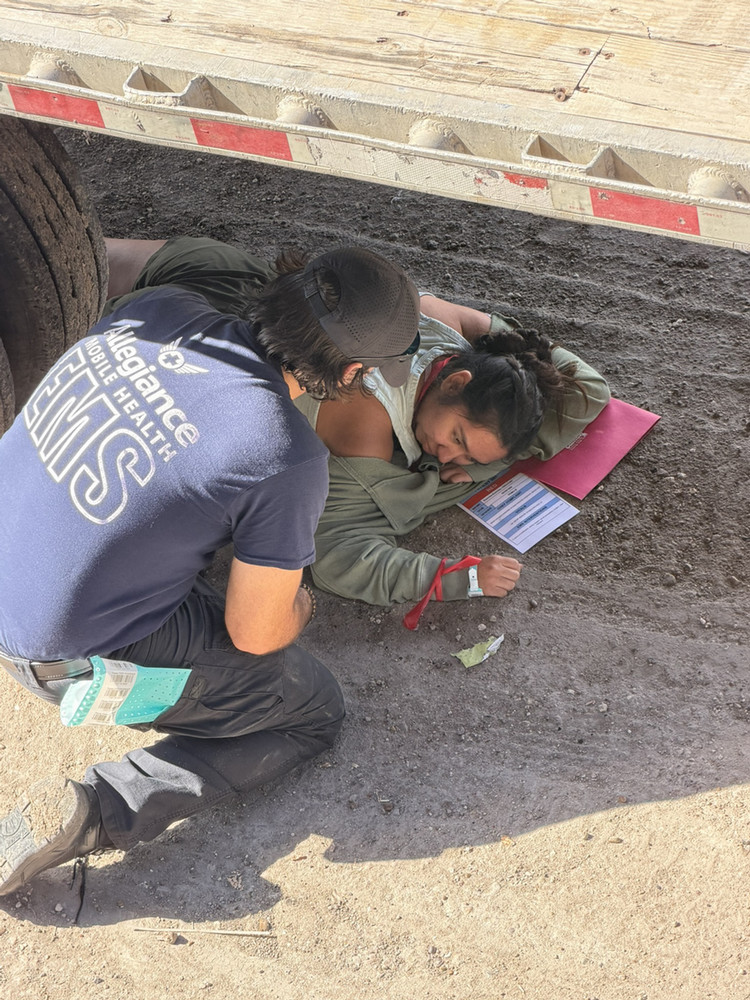
The large-scale emergency exercise, coordinated by the Coastal Bend Regional Advisory Council, brought together agencies from across the region to test coordination among hospitals, EMS agencies, public health officials, and emergency management teams. For nursing student Celeste Larrahona ’26, the experience was as intense as it was eye-opening. Her assigned role placed her beneath the semi-truck, motionless and critically injured.
“We get tested in our first semester about triage and mass casualty tag colors, but to see it in action was invaluable,” Larrahona said
To heighten realism, volunteers were covered in theatrical makeup depicting bruises, burns, and deep lacerations. After receiving treatment at the scene, the mock patients were transported to hospitals throughout the Coastal Bend.

“Once we were triaged at the scene, we were allowed to go to our cars and drive to our assigned hospital where the exercise continued,” Griffis said. “I was assigned to Bay Area Medical Center, where a doctor evaluated me. Then, I was moved to triage, where physicians and nurse practitioners continued assessments. Labs and X-rays were ordered before I was taken to an ICU bay before the simulation ended.”
Larrahona was assigned to CHRISTUS Spohn Alice, where she witnessed the fast-paced teamwork of an emergency room firsthand. It was an experience that only deepened her passion for emergency medicine.
“I’m an adrenaline junkie — I thrive in those environments,” Larrahona said. “There’s also so much teamwork involved in working in an emergency department and it was really cool seeing that up close.”
Professors in the College of Nursing and Health Sciences hope to expand opportunities like this in the future, giving more students a chance to train alongside emergency professionals in realistic, high-pressure scenarios.
“You can lecture students all day long,” Griffis said, “but until they get hands-on experience, whether in the lab or out in the field, it doesn’t truly click.”

For Larrahona, the exercise lasted about four hours, but the experience gained will last a lifetime.
“It was really amazing to see the nurses in action and to see how fast they think,” Larrahona said. “They were able to do things and communicate efficiently while they assessed me. I can’t wait to get to that point, and I know I’m on my way.”
This is archived content and was published before April 26, 2027. While we are committed to making our digital spaces accessible to everyone, some parts of this archived content may not fully comply with WCAG 2.1 Level AA standards.
If you require a specific news article in an accessible format, please contact us at webhelp@tamucc.edu. We will work to provide the content to you in an accessible format within five working days.