Building Scientists from Day One: Hands-on Learning Defines the Chemistry Program at TAMU-CC


CORPUS CHRISTI, Texas — At the Island University, where classroom lessons meet real-world discovery, undergraduate research is more than an opportunity. It’s a transformational experience. With personal mentorship, real lab duties, and projects addressing scientific frontiers and societal needs, undergraduates gain a deeper sense of purpose, confidence, and a vision for their future.
One of the many faculty members who lead labs at TAMU-CC is Dr. Mark Olson ’05, Associate Professor of Chemistry. Olson, a Corpus Christi native, once walked the same hallways as his Islander students. After graduating from Roy Miller High School, he earned a Bachelor of Science in Chemistry from TAMU-CC while working in the research lab of husband-and-wife professor pair, Drs. Eugene and Fereshteh Billiot.
“Stepping into the Billiots’ lab was like opening the floodgates to opportunity,” Olson said. “I learned that the most valuable skills aren’t always found in textbooks; they’re passed down from mentor to student, from one generation of scientists to the next.”
Eventually, Olson studied for his Ph.D. under 2016 Nobel Prize winner Sir James Fraser Stoddart. This connection makes Olson’s students part of what he fondly calls “Nobel grandbabies,” a generation of researchers descended from Nobel-winning mentorship.
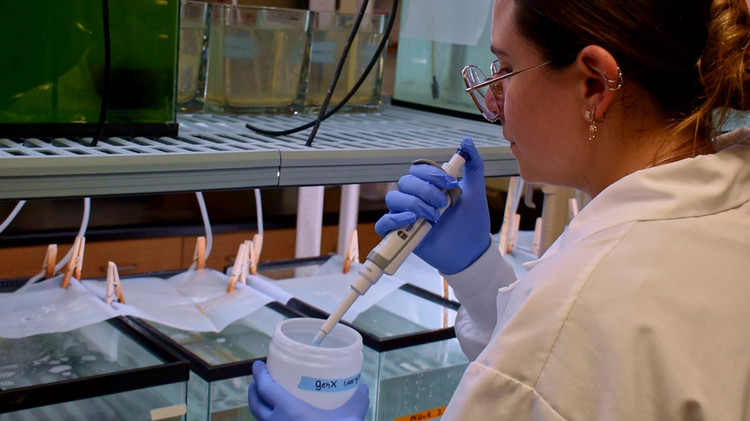
Olson’s research group focuses on organic synthesis, creating what is known as functional or stimuli-responsive materials, molecules that change in response to changes in their environment. These materials can visibly shift properties like color when exposed to temperature changes or upon exposure to UV light.
“It’s like a blacklight poster,” Olson said. “That glowing effect is fluorescence, and we’re designing molecules that respond similarly but with highly controlled, customizable behaviors.”
Connor Duncan ’25, ’27, a chemistry major and Flour Bluff ISD graduate, is one of about a dozen student researchers in Olson’s lab. Earlier this year, he joined Olson at Texas Undergraduate Research Day at the Texas Capitol to present their work. They also co-published research with NYU Abu Dhabi in “Nature Communications,” titled, “Triple Energy Conversion Cascade in a Densely Charged Redox Active Covalent Organic Actuator.”
“I didn’t really know what I wanted to do until I took Dr. Olson’s class as a freshman. That experience got my foot in the door early and helped me realize my passion,” Duncan said. “From there, I was able to spend a lot of time in the research lab, building skills that set me on my path.”
Olson’s students are integrating chemistry, engineering, and design in a way that puts undergraduates on the front lines of innovation. Students have developed a system of small molecule-based inks that are compatible with desktop inkjet printers and appear red under visible light, shift to yellow when heated, and turn green at higher temperatures.
“This is important for real-world applications,” Olson said. “Imagine inkjet printing these compounds onto paper stickers that can monitor the temperature of engines or electronic devices. If a dangerous heat threshold is reached, the sticker changes color permanently, even if no one was there to witness the initial thermal change.”
Sara Yniguez ’25, who graduated this spring with a double major in biochemistry and biomedical sciences, began working in Olson’s lab as a first-year Islander with no prior lab experience. Born and raised in Corpus Christi, Yniguez, also a Flour Bluff ISD graduate, saw TAMU-CC as a smart and affordable step before continuing a path toward medical school. Her younger sister Kate Yniguez ’29, a sophomore planning to pursue a career in pharmaceuticals, now works in the same research lab.
“I spoke to Dr. Olson about how much I wanted to get more involved in research, and he was immediately open to the idea,” Kate Yniguez said. “He invited me into his lab, and that moment really changed things for me when it came to actually seeing what science looks like in real life.”
Olson was recently awarded a $250,000 National Science Foundation grant supporting the development of fluorescent molecular sensors for pollutant detection. An additional $70,000 award from the American Chemical Society Petroleum Research Fund fuels his team’s work on visible-light photopolymerization.
The undergraduates in Olson’s lab this semester include Sarmad Ayad ’29, Ciara Bohn ’26, Charles Jackson ’25, Leah Marr-Lyon ’26, Alexis Alaniz ’26, Mei Ou ’29, Sebastian Chacara ’29, and Kate Yniguez ’29, along with graduate students Victoire Delattre ‘23, ’25, Connor Duncan ’25, ’27, Emily Hall ’25, ’27, and Dante Morland ’24, ’26.
Beginning in fall 2026, TAMU-CC will establish the Department of Chemistry and Biochemistry, which will align better with research goals and put the degree plan on a path to be accredited by the American Chemical Society.
This is archived content and was published before April 26, 2027. While we are committed to making our digital spaces accessible to everyone, some parts of this archived content may not fully comply with WCAG 2.1 Level AA standards.
If you require a specific news article in an accessible format, please contact us at webhelp@tamucc.edu. We will work to provide the content to you in an accessible format within five working days.