Where Where Leadership Meets Local Impact: Master of Public Administration Celebrates Its 35th Anniversary
Texas A&M-Corpus Christi’s Master of Public Administration program celebrates 35 years of preparing working professionals to lead in government and public service.
Texas A&M-Corpus Christi’s Master of Public Administration program celebrates 35 years of preparing working professionals to lead in government and public service.
In a region where public decisions shape everything from stormwater fees to hurricane readiness, Texas A&M-Corpus Christi’s Master of Public Administration program has spent the last 35 years training the people who make government work.
Launched in 1991, the MPA program has grown with the Island University itself, evolving with the needs of working professionals who serve the Coastal Bend and beyond.
Now celebrating its 35th anniversary, the program reflects three and a half decades of preparing public servants to lead with clarity and purpose. Many students arrive midcareer, already managing teams, budgets, and community expectations. They come looking for a stronger toolkit and leave with skills and applied experience they can take straight back to the office.
“Most of our students are full-time professionals,” said Dr. Isla Schuchs Carr, Chair of the Department of Social Sciences and former coordinator for the MPA program and its graduate certificates. “That reality shapes how the program operates and why it has stayed flexible. The program offers a hybrid structure, with courses in both face-to-face and online formats to meet the demands of public sector schedules.”
The MPA is a traditional 36-hour graduate program. There are also two 15-hour graduate certificates designed for professionals who want focused training without committing to a master’s degree. One is a Homeland Security Graduate Certificate, which can stand alone or pair with the MPA. The other, a newer Public Management Graduate Certificate, gives students in other disciplines a way to formalize public sector expertise they may already be building through elective coursework.
“It is an option that can serve students headed for agency work, utilities, healthcare administration roles, and other public-facing careers,” Schuchs Carr said.
That broader reach matches what alumni say drew them in.
Sylvia Carrillo-Trevino ’02, ’04, City Manager for Bastrop, located east of Austin, did not start out planning to earn an MPA. For her, an elective course shifted her direction and introduced her to city management as a career path. After an internship in the Corpus Christi City Manager’s Office, everything clicked and Carrillo-Trevino found her calling.
“I absolutely love working in city government,” Carrillo-Trevino said. “This is what I want to do.”

She credits the program with sharpening both her technical and people-centered skills — from interpreting data to navigating collaboration across departments. She also pointed to the network built in the classroom, a cohort of professionals who became practical sounding boards later in her career.
“That network that I was able to create became a resource when I needed perspective from peers working in other areas of government,” Carrillo-Trevino said.
Jason Brady ’16, Chief of Police for the Seguin Police Department, entered the program while serving as a captain with the Corpus Christi Police Department. He enrolled looking for leadership training which went beyond the core work of law enforcement.
“In law enforcement, you could be the best cop,” Brady said, “but if you do not understand how to write policy and you do not understand how to budget properly, then you will be less effective in a police management role.”
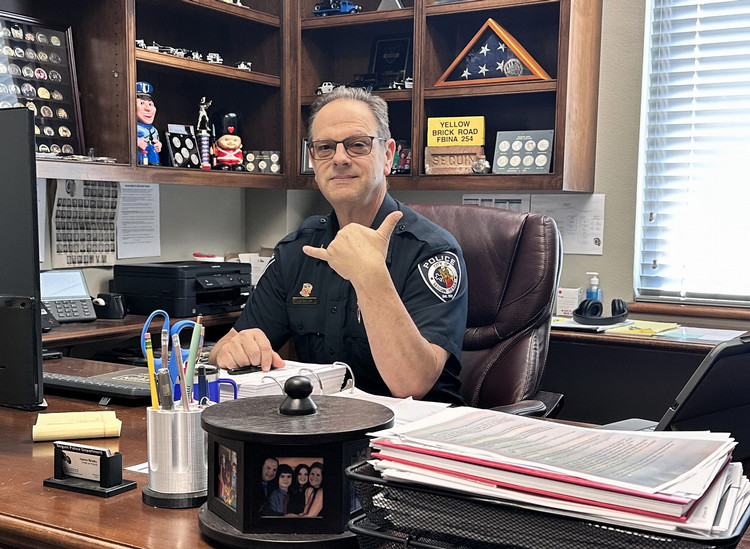
For Brady, the program taught him to look at public safety from inside the ecosystem of city government — where finance, facilities, parks, fire, and police all operate as one team with shared constraints and shared goals.
That applied, cross-sector lens sits at the center of the MPA experience. Faculty emphasize decision-making grounded in evidence, budgeting which reflects real-world tradeoffs, and management theories which explain why a strategy works in one setting and fails in another.
According to Schuchs Carr, graduates most often return to talk about the program’s budgeting course, because it teaches students to evaluate financial information and make defensible decisions.
“I am not teaching them to be financial analysts,” Schuchs Carr said. “I am teaching them to understand the report when the financial analyst brings it to you.”
The same practical emphasis shows up in the program’s capstone work. Recently, students have partnered with local entities to create projects that tackle applied questions. Schuchs Carr described a project with the City of Corpus Christi’s facilities management team which compared policies and practices for building upkeep in places with similar environmental challenges, including heat, humidity, and salinity. Other projects have included needs assessments and program evaluations connected to public agencies, sometimes designed in earlier coursework and developed into capstone-level work.
These collaborations matter because they give students the kind of experiences they can point to in an interview and provide value to community partners at the same time.
As the program marks its 35th anniversary, it also stands on the edge of another milestone: pursuing program accreditation through the Network of Schools of Public Policy, Affairs, and Administration (NASPAA), the primary accrediting body for public service education programs. Schuchs Carr said the program received eligibility approval and plans to submit its self-study this August. If successful, the program expects an accreditation decision in 2027.
The effort reflects both ambition and continuity, documenting what the program has built and where it plans to go. The anniversary also opens a window into the program’s early foundation, including the faculty who helped shape it when the university and region looked different.
In 1991, graduate options in the social sciences at the university were limited. The new MPA degree filled a clear gap for working professionals across the region.
“The MPA was needed for employees who wanted to advance in government and nonprofit sectors,” said Dr. Philip Rhoades, Professor of Criminal Justice and a Texas A&M University System Regents Professor who retired in 2022. “No other degree was available in the region, and online degrees did not exist.”
Early cohorts reflected South Texas’ public service workforce. Students included police officers, federal agents, probation and parole officers, victim services professionals, and employees in state and federal corrections systems. Some held supervisory roles, while others saw the degree as a stepping-stone toward promotion.
“The focus was on a degree that would support the advancement of careers,” Rhoades said.
The Coastal Bend’s needs helped shape the program from the start. Local and regional agencies needed trained supervisors and administrators but often struggled to recruit from outside the area. The program offered a way to grow that leadership locally.
“We saw some governments, especially the City of Corpus Christi, encourage and help fund employees to enter the degree program,” Rhoades said. “We had students commuting from places like Laredo and Victoria because there were so few other options available.”
Over time, informal relationships between faculty and local agencies evolved into stronger partnerships, including advisory support from practitioners in the field. Those connections helped ensure the curriculum remained grounded in the realities of public service work.
Looking back after more than three decades, Rhoades hopes the program’s legacy is measured by the influence of its graduates.
“It is nice when people recognize the impact our graduates have had in improving management and administrative practices in the region over the years,” Rhoades said.
That impact can be seen across the region in graduates who have moved into leadership roles in city government and public service. Carrillo-Trevino and Brady are just two examples. Others have taken on key roles closer to home, including Arlene Medrano ’15, Executive Director of the Corpus Christi Downtown Management District, and Amanda Torres ’10,’16, who leads building and development services for the city of Rockport. Together, they reflect the program’s reach across South Texas and beyond, where alumni apply what they learned to the day-to-day work of governing communities.
After 35 years, the Island University’s MPA program still attracts students who want careers defined less by spotlight and more by responsibility. Some serve in city halls. Others lead public safety agencies. Others build careers in nonprofits, utilities, higher education, and public-facing organizations where governance and community trust matter.
This is archived content and was published before April 26, 2027. While we are committed to making our digital spaces accessible to everyone, some parts of this archived content may not fully comply with WCAG 2.1 Level AA standards.
If you require a specific news article in an accessible format, please contact us at webhelp@tamucc.edu. We will work to provide the content to you in an accessible format within five working days.