Built in 48 Hours, Bound for the World


CORPUS CHRISTI, Texas — The clock started at 48 hours. It started with no roadmap or pre-assigned teams. It started with a roomful of Islanders from wildly different disciplines, a global challenge they had never seen before, and the freedom to build something that matters.
That is the premise of Invent for the Planet (IFTP), an international innovation competition organized by Texas A&M University and hosted simultaneously at universities across the globe each spring. Teams have 48 hours to identify a problem worth solving and develop a viable, marketable solution from scratch. This year's competition featured 32 universities in 17 countries trying to solve the 2026 IFTP theme — Reimagining Food Systems for a Resilient Planet.
Dr. José Baca, Associate Professor of Engineering, has watched that weekend unfold from the inside nearly every year since TAMU-CC joined the competition. He has seen teams soar and stall and find their footing at midnight. He knows what the good ones look like.
“You get to see them from the very beginning,” Baca said. “You see how the idea starts, how they develop solutions, and how they overcome the challenges.”
This year's winning team, Hydro Optix, emerged from the Island University's competition with not only a first-place finish on campus, but also a sixth-place ranking among participating universities worldwide — earning them a trip to the global finals in Ireland.
Hydro Optix featured a trio of research partners — Kimberly Lopez ’22, ’26; Aleena Roy ’26; and Christopher Salazar ’24, ’26.
For Salazar, a first-generation electrical engineering graduate student from Corpus Christi, having at least two members he was already familiar with made the uncertainty of IFTP seem a little less intimidating.
“I have trust in them," Salazar said. "Everything we do together, we get good results.”
The rest of the seven-person team — Christina Gonzalez ’26, Sophia Hernandez ’28, John Lava ’28, and Vishakan Umapathy ’26 — filtered in from medical laboratory science, marine biology, engineering, and computer science. For Lopez, the blend of academic backgrounds drove their success.
"Everybody was different and we all came together," Lopez, a first-generation student from the Rio Grande Valley pursuing a Master of Science in Electrical Engineering, said. "Everybody picked their topic and went off on it. Normally one person does all the work, but this time, everybody was a team leader."
The first 24 hours were far from glamorous. Competing ideas pulled the group in different directions. Salazar wanted to lean into greenhouse agriculture — a topic he knew well from his thesis research.
"We don't have a lot of time — 48 hours," he said. "I thought, this will be how we can sound the most professional, because I can take the lead on this and we'll have a big leg up."
But Lopez and Roy worked through the night chasing a different thread entirely, one that felt more urgent. By morning, they were ready to make their case. The challenge they landed on — the water demands of artificial intelligence data centers.
Every time a user interacts with a large AI model, data centers consume water to cool their systems. That water circulates through cooling towers, gradually accumulating contaminants until it triggers a “blow-down event” — a full system flush which can consume millions of gallons in a single cycle. Meanwhile, much of the steam produced in the cooling process simply escapes into the atmosphere, unrecovered.
“The team looked at how we can maximize use, so you don't need to use so much new water,” Baca said.
The solution they came up with was a sensor-based system, integrated directly into existing data center pipelines, which monitors water quality in real time. The system would end blow-down events as soon as water is ready for reuse rather than running a fixed, potentially wasteful cycle. Separately, the system would also capture condensation — already distilled and contaminant-free — and return it to circulation before it escapes into the air.
Lopez made the conceptual leap from her lab work.
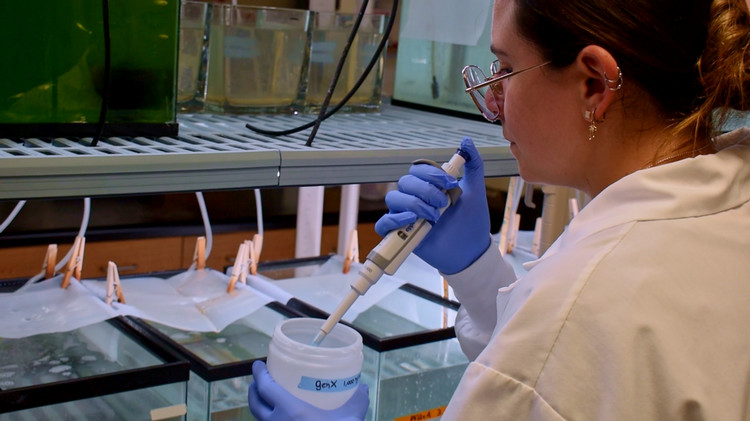
“I thought of a laboratory distiller,” Lopez said. “It’s a glass ball with a tube, and you boil the water so that it condensates and collects.”
Salazar framed the idea in plain numbers. If a blow-down event consumes one million gallons and the system cuts that in half, that's 500,000 gallons recovered per event, per facility. Multiply that across a global industry building data centers at an accelerating pace, and the potential compounds fast.
“If it's cheap and it can integrate directly into what they already have, then it's a no-brainer," Salazar said. “You're saving water, your energy bill is lower, and your pumps last longer.”
The team estimates a realistic reduction in water consumption of 5-20%.
Weeks later, in a lab meeting, Lopez’s phone lit up with a text message saying they had been selected for the global finals. She slid the phone silently to Baca, then to Roy, and finally Salazar. They were stunned.
“Hopefully we’re doing some good for the world,” Lopez said.
The group will be TAMU-CC’s second to compete at the global level. For Baca, watching a program he has helped build send teams to a global stage fills him with pride.
“They managed the pressure, worked through the challenges and turned an idea into something real in a very short time,” Baca said.
The competition came to TAMU-CC in 2019, brought to campus by Sharmeen Ahmed, a former member of the Division of Research and Innovation, who saw in it the kind of challenge which pulls students past what they think they can do.
For Baca, the value runs deeper than any single placement.
"When you're out there in the world looking for jobs or already working in a company, you will always be working on teams," Baca said. "Being able to work as a team, delegate tasks, meet deadlines — this experience is a little glimpse of what is coming next."
In May, that glimpse becomes the main event.
This is archived content and was published before April 26, 2027. While we are committed to making our digital spaces accessible to everyone, some parts of this archived content may not fully comply with WCAG 2.1 Level AA standards.
If you require a specific news article in an accessible format, please contact us at webhelp@tamucc.edu. We will work to provide the content to you in an accessible format within five working days.