Ed.D. Program Redesign: A Three-Year, Data-Informed Process
by Kevin J. Bazner, Ph.D., Assistant Professor of Educational Leadership
The Doctor of Education (Ed.D.) in Educational Leadership at Texas A&M University–Corpus Christi will relaunch in Fall 2026 following a three-year redesign process focused on aligning the program with the needs of working professionals and the skills of applied leadership practice.
While conversations about program changes had been ongoing, the redesign formally began in Summer 2023 with a review of 61 dissertations completed between 2017 and 2023. This analysis examined dissertation type, methodology, and problem focus. One consistent finding was that students were using their dissertations to investigate local problems of practice, but this work was not clearly connected to the structure of the curriculum. This gap informed a shift toward a more explicit scholar–practitioner model grounded in improvement science.
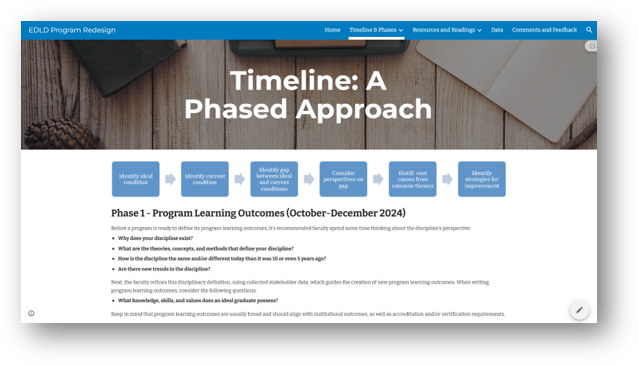
The redesign process was structured to allow sustained faculty engagement and regular input from students and alumni. Dedicated working sessions were held outside of standard department meetings, and a shared redesign website was developed to document timelines, decisions, and working materials, including curriculum maps and process guidelines. The website also outlined the phases of the redesign, from initial data collection through curriculum development and implementation, providing a clear structure for the multi-year effort (see Figure 1).
Figure 1. Ed.D. Program Redesign Timeline and Phases (Website Screenshot)
A department retreat in November 2024 served as a key point for consolidating this work. Faculty revised program learning outcomes, updated admissions criteria and processes, and restructured the curriculum around improvement science principles. The program also drew on national benchmarks, including guidance from the Carnegie Project on the Education Doctorate (CPED), to inform decisions about program structure and dissertation design.
Student and alumni feedback played a central role. A survey distributed in December 2024 to current and former students confirmed strengths in faculty support and professional relevance, but also identified areas for improvement. Respondents pointed to the need for clearer milestones, stronger alignment between coursework and dissertation work, and more structured support during the dissertation process. These findings led directly to the adoption of an embedded dissertation model. In the redesigned program, coursework is intentionally sequenced around dissertation milestones, and students engage in iterative Plan–Do–Study–Act (PDSA) cycles throughout the program.
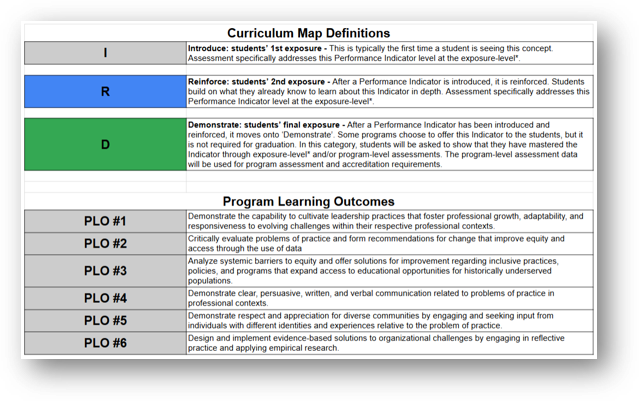
To support this structure, the program developed a shared curriculum mapping framework that defines how learning outcomes are introduced, reinforced, and demonstrated across the program. This framework provides a consistent way to align coursework with expected student development and program goals (see Figure 2).
Figure 2. Curriculum Map Definitions and Program Learning Outcomes
The redesigned Ed.D. program includes four administrative tracks: Principalship, Superintendency/District Leadership, Higher Education Administration, and Public Administration. The Public Administration track is a new collaboration with the Public Administration program in the College of Liberal Arts and expands interdisciplinary options for students.
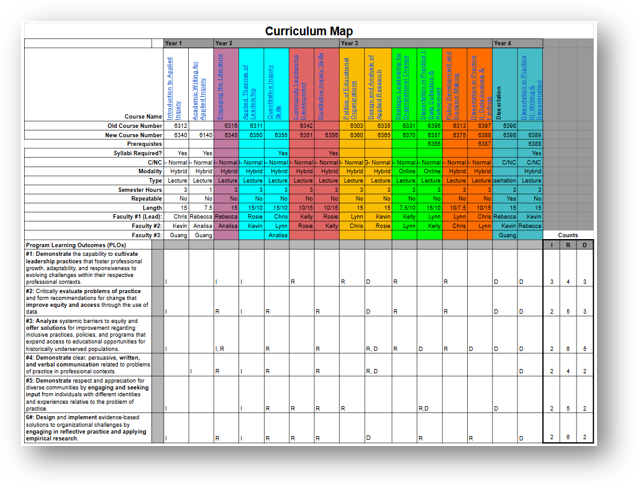
The full curriculum map illustrates how courses are sequenced and aligned with program learning outcomes and dissertation milestones. It shows where outcomes are introduced, reinforced, and demonstrated across the program, as well as how improvement science cycles are integrated throughout coursework (see Figure 3).
Figure 3. Curriculum Map with Course Sequence and Learning Outcome Alignment
The program is designed for working professionals who are responsible for leading change across PK–12 schools, higher education, community organizations, and public agencies. Graduates will be better positioned to define problems of practice, use data to analyze systems, and apply research to guide decision-making and improvement efforts. Embedding dissertation work across the curriculum is intended to provide a more consistent pathway to completion while increasing the relevance of doctoral work to professional contexts.
The redesign process and resulting program model will be featured at the Carnegie Project on the Education Doctorate (CPED) conference hosted by Texas A&M University–Corpus Christi in October.