Water Updates
August 3, 2026
On-Campus Initiatives
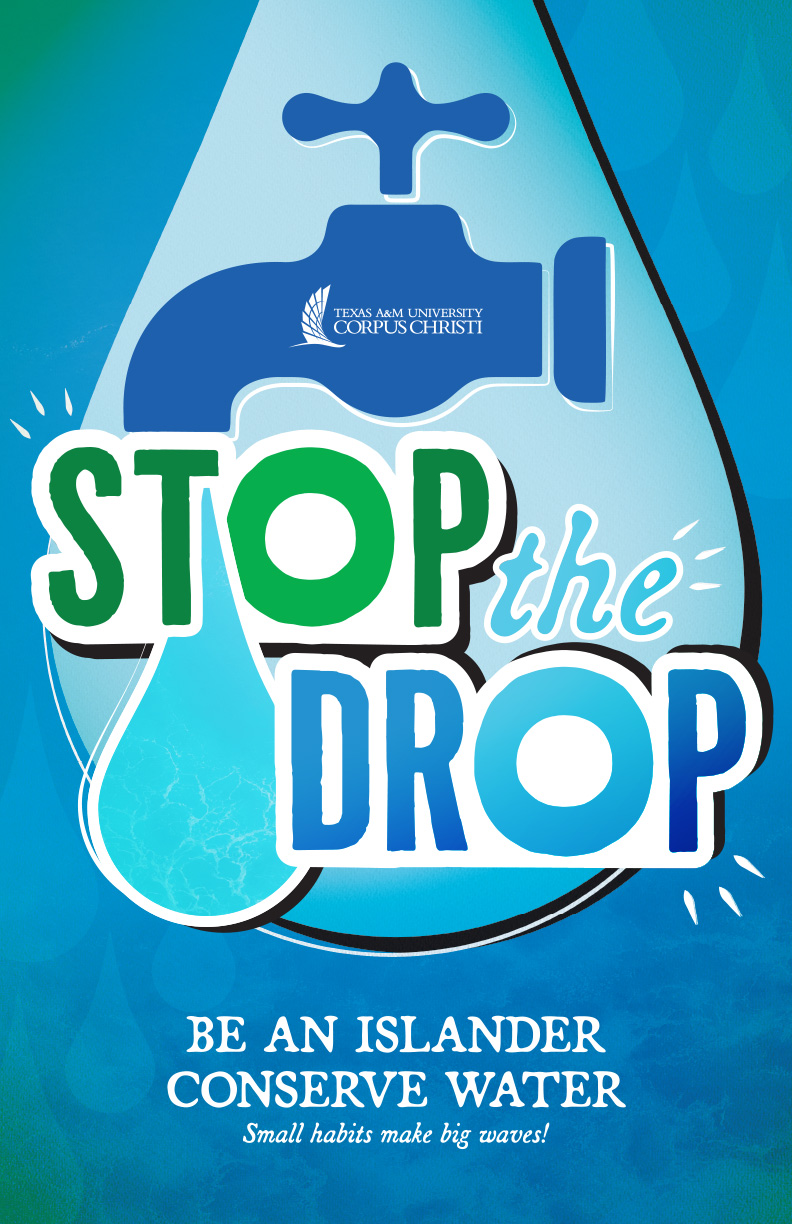 Stop the Drop
Small habits make big waves. Be an Islander and help conserve water! The Stop the Drop campaign encourages students, faculty, and staff to make simple, everyday choices that reduce water waste and protect our most valuable resources. From turning off the tap to taking shorter showers, every drop counts. Together, we can make a difference—one small habit at a time.
May 12, 2026
Working with the City and Our Partners
Our university leadership is actively engaged with the City of Corpus Christi and our engineering partner, Freese and Nichols, Inc., to finalize our comprehensive water strategy. While we do not yet know the exact curtailment parameters the City will require, we are not waiting for that determination to act. As members of this community, we are committed to being good partners, and we believe that means taking meaningful steps now, rather than later.
We are also working diligently alongside City officials and the Corpus Christi Fire Department on emergency management planning and will continue to do so as the situation evolves. Campus safety remains our top priority, and we are committed to being a collaborative and responsible partner as our community navigates this challenge together.
Our Ongoing Efforts to Reduce Water Usage
Texas A&M-Corpus Christi has made substantial progress in reducing campus water consumption, and that work is ongoing. Our facilities team, Campus Water Task Force, and campus partners are actively pursuing new conservation measures, including advancing a solution to use effluent water for the Central Utility Plant’s chilling tower, a major infrastructure investment that would significantly reduce our dependence on City water for cooling operations across campus.
Freese and Nichols continues its assessment of potential groundwater supply options on our Ward Island campus and is evaluating additional alternative sources, including atmospheric harvesting and use of reclaimed water from the Oso Wastewater Treatment Plant. We look forward to sharing the results of that work with you as it becomes available.
The Expertise of the Island University
What sets Texas A&M-Corpus Christi apart in this moment is not only our role as a community anchor and operational partner, but also the depth of expertise within our own faculty and research community. Our scholars have spent years, in many cases entire careers, working across disciplines to advance the science that informs water policy and drives real-world solutions to some of the most pressing challenges of our time.
Right here at the Island University, we are home to some of the world’s leading researchers in freshwater inflows to bays and estuaries, and in the state and legal frameworks governing environmental flows. Our faculty bring expertise in desalination, groundwater, coastal water quality, the role of vegetation in surface water runoff and flood mitigation absorption, meteorology, the science of drought, and the economic dimensions of water scarcity and regional development. These are not abstract academic pursuits; they are the foundational disciplines that shape water strategy at the local, state, and national level.
As we navigate this challenge alongside our community, we are committed to making that expertise available in service of Corpus Christi and the broader region. The Island University is not just a place affected by this crisis; we are part of the solution.
How Every Islander Can Help
Water conservation is a shared responsibility, and every action matters. Here are steps all of us can take, whether on campus or at home:
- Turn off the tap while brushing your teeth or washing your hands. This alone can save several gallons per day.
- Report leaks immediately. If you notice a dripping faucet, running toilet, or leaking fixture anywhere on campus, please submit a Work Order Request right away.
- Take shorter showers. Reducing your shower time by even two minutes can save up to 10 gallons of water.
- Run dishwashers and washing machines with full loads only.
- Avoid running water unnecessarily when rinsing dishes, defrosting food, or cleaning.
These may seem like small steps, but together they add up, and they reflect the kind of community care that defines who we are as Islanders.
Texas A&M University-Corpus Christi is closely monitoring the ongoing water supply situation affecting our community. The health, safety, and well-being of our students, faculty, and staff remain our highest priority, and we want our campus community to know that we are actively engaged in addressing this challenge.
What We’ve Done
Texas A&M-Corpus Christi has been committed to responsible water stewardship for years, long before this crisis reached its current state. That work is reflected in our numbers. Our campus water usage has declined significantly and consistently:
| Fiscal Year | Avg. Gallons/Month |
|---|---|
| FY2024 | 7,743,917 |
| FY2025 | 5,929,568 |
| FY2026 (Year-to-Date) | 5,039,833 |
This progress is the result of real, sustained investment across campus. We have:
- Implemented an effluent water system for irrigating Athletics facility fields.
- Completed a campus-wide retrofit of toilets, urinals, sinks, and showerheads with low-flow devices.
- Installed Zurn 1.25-gallon water-saving showerheads and aerators on sinks in Housing units.
- Adjusted flush valves on toilets and floats in toilet tanks throughout campus to prevent overfilling.
We have also established a Campus Water Task Force comprised of university administrators, facilities management experts, and key stakeholders charged with monitoring all developments in real time, coordinating with community and government partners, and protecting the continuity of campus operations and student life.
What We’re Doing Now
Our response is active and ongoing on multiple fronts. On campus, we are continuing to identify and implement additional conservation measures, including:
- Inspecting and recalibrating all automatic sensor faucets campus-wide to ensure minimum run-time settings.
- Benchmarking with peer institutions to identify additional water-saving strategies we can put in place quickly.
- Exploring opportunities to reduce water usage at the Central Utility Plant through optimized blow-down practices and installation of tower basin level sensors.
We have also engaged Freese and Nichols, Inc. to assess potential groundwater supply options on our Ward Island campus and address key treatment considerations, including:
- Hydrogeologic assessment of groundwater availability.
- Technical and regulatory feasibility of developing groundwater as a public water supply.
- Treatment requirement for brackish groundwater.
- Associated risks and constraints.
- Preliminary cost estimates for infrastructure and treatment systems.
In addition, Freese and Nichols will explore additional alternative water sources, including:
- Atmospheric harvesting.
- Use of reclaimed water from the Oso Wastewater Treatment Plant.
- Use of campus effluent.
Beyond our campus, we are engaging with community and state leaders who are working to address this crisis.
- City of Corpus Christi: University leadership has met and will continue to meet with city officials on emergency water management planning.
- Corpus Christi Regional Economic Development Corporation: We continue to work alongside the CCREDC and other community leaders to ensure our response is coordinated with the broader regional effort. What is good for Corpus Christi is good for our students, our university, and our future.
- Texas A&M University System: Chancellor Glenn Hegar and System leadership are actively engaged with us as we navigate this challenge. They have expressed their full support for Texas A&M-Corpus Christi, and we are grateful for that partnership.
- Texas AgriLife Extension – Texas Water Resources Institute: We have met with Texas Water Resources Institute Director Giovanni Piccinni, who is actively providing technical assistance and expertise to help guide our water strategy. The Institute’s involvement reflects the kind of research partnership that makes this university a resource for all of South Texas.
- Governor’s Office: We are grateful to Governor Greg Abbott for his swift and decisive action in supporting Corpus Christi, and we are encouraged by the state’s commitment to working with our community toward sustainable, long-term solutions.
Where We’re Headed
This is a pivotal moment, and Texas A&M University-Corpus Christi intends to meet it with the same innovation and purpose that defines this university. We are committed to being part of the long-term solution.
In the weeks and months ahead, we will:
- Continue to reduce campus water consumption through strategic infrastructure investments and university-wide conservation efforts.
- Continue our partnerships with city, state, and regional leaders to stay abreast of the rapidly changing situation.
- Leverage the research and academic expertise of our university and our partners, including the Texas Water Resources Institute, to ensure we explore and maximize every opportunity for our campus.
- Communicate with you as conditions evolve, so that every Islander has the information they need to make informed decisions for themselves and their families.
- Strengthen and advance research currently underway at Texas A&M-Corpus Christi to provide the knowledge and innovation needed for the long-term water security of our region and beyond.