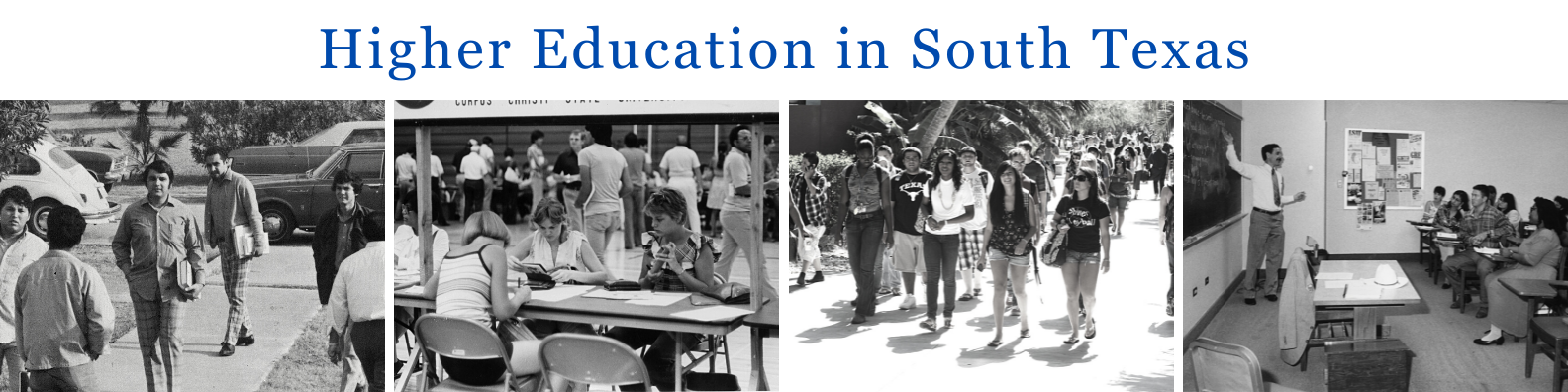
From Access to Economic Development: Texas A&M University-Corpus Christi and the South Texas Economic Development Center
by Long Pham
Regional public universities in Texas were not always expected to be engines of economic growth. When Texas A&M University-Corpus Christi (TAMU-CC) first opened as a public institution in 1973, its promise to South Texas was simple: give place-bound residents of the Coastal Bend a chance to finish a degree close to home. Four decades later, in 2014, the Texas A&M University System approved the South Texas Economic Development Center (STEDC), a unit created to provide “data-driven analytics and technical assistance” to business and government leaders. This exhibit traces how the university’s obligation to its region moved from educational access to applied economic research. Using catalogs, newsletters, impact reports, and the Center’s own studies, it argues that today’s expectation that regional universities prove their worth in dollars and jobs is a historical choice, not a timeless mission. That choice still shapes debates today, as public universities across Texas are asked to justify their funding through economic impact figures.
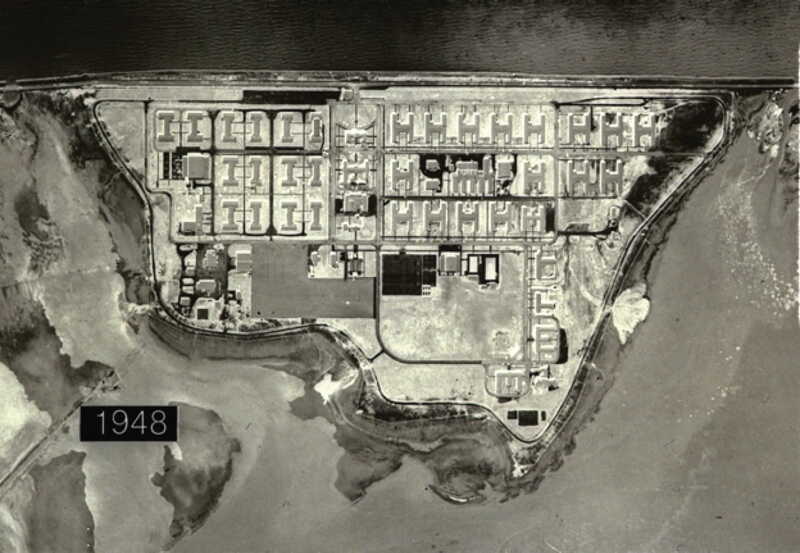
The Island University, 1947–1994
Higher education on Ward Island began in 1947, when the University of Corpus Christi, a Baptist college, moved onto a former Navy base on Corpus Christi Bay. Hurricane Celia badly damaged the campus in 1970, and the struggling college looked to the state for help. On June 10, 1971, Governor Preston Smith signed a bill creating Texas A&I University-Corpus Christi as an upper-level public university. Local citizens made the change possible. In December 1972, Corpus Christi voters approved a bond package with 78 percent support, and donors raised $1.8 million more (Johnson, 2021).
Classes began in September 1973. As an upper-level school, A&I-Corpus Christi admitted only transfer students who had already earned 60 credit hours, many of them from nearby Del Mar College. It also offered graduate degrees in Corpus Christi for the first time. Most students commuted, worked full time, and were older than typical undergraduates. Enrollment reached 1,603 by 1974–75. When the first new classroom building opened in 1975, it was named Corpus Christi Hall. President D. Whitney Halladay explained why: “The people of this city made our university possible.”
In 1977 the school became Corpus Christi State University (CCSU), part of the University System of South Texas. In 1989 the Legislature moved it into the Texas A&M University System, and the first freshmen arrived in fall 1994 under the new name Texas A&M University-Corpus Christi. Today, the five spires of the MOMENTUM sculpture at the campus entrance stand for the five institutions in the Island University’s history. Each change of name was also a change of purpose.
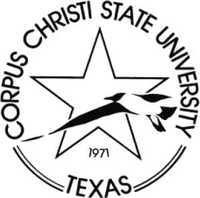
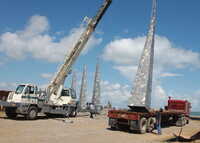
As you can see in these photographs, the Island University’s buildings and signs record each new identity. Corpus Christi Hall was the first building constructed after the campus became public, and its name honors the voters and donors who paid for the change. The CCSU entrance sign and seal mark the second public name, adopted in 1977. Notice the seal’s date of 1971, the year the state created the public university; President Robert Furgason later changed the official seal date back to 1947 to unite alumni of every era (Johnson, 2021).
A Changing Mission: From Access to Economic Need
Every university catalog opens with a mission statement. Because TAMU-CC and its earlier versions printed a catalog almost every year, those statements let us watch the institution describe itself over time.
When the campus became public in 1973, its core mission dropped ministerial training and turned to “the needs of underserved students primarily from South Texas” (Johnson, 2021). Alumni like Ricardo L. Rodriguez show what that meant. A Navy veteran of the Vietnam War, Rodriguez earned an associate degree at Del Mar College, transferred to CCSU while working, and became a first-generation college graduate in accounting. He was elected Mayor of Robstown in 1980.
In the 1980s, the meaning of regional service grew from access to equity. A 1988 report found that Texas spent $43 per student in South Texas but $103 per student elsewhere in the state. In 1987, the League of United Latin American Citizens (LULAC) sued the state in LULAC v. Richards, charging discrimination against Mexican Americans through underfunded higher education. The Legislature answered in 1989 with the South Texas/Border Initiative, which sent more than $880 million in special funding to South Texas institutions between 1990 and 2003, and with the merger that brought CCSU into the Texas A&M System (Johnson, 2021).
By 2021, the university’s mission statement described its Hispanic-Serving Institution status as “a foundation for closing educational gaps.” Its vision statement added a newer promise: to “invigorate and strengthen the region and state through its educational programs, research initiatives and outreach efforts” (Johnson, 2021). Today’s catalog says the university serves “the intellectual, cultural, social, environmental, and economic needs of South Texas.” Access and equity remained, but the word economic now sits inside the mission itself.
Tracking the Language of Mission
The table below compares how the university described its purpose at different moments, using its catalogs and published mission statements. A check mark means the idea appears in that statement. Watch for the moment when access is joined by careers, outreach, and finally the word economic.
| Year and source | Access / opportunity | Serving South Texas | Careers / professionals | Outreach beyond campus | Economic needs |
|---|---|---|---|---|---|
| 1973 Mission as described by Johnson (2021) Texas A&I University-Corpus Christi |
✔ | ✔ | — | — | — |
| 1995–96 Catalog, Statement of Institutional Purpose Texas A&M University-Corpus Christi |
✔ | ✔ | ✔ | ✔ | — |
| 2021 Vision and Mission Statements (Johnson, 2021) Texas A&M University-Corpus Christi |
✔ | ✔ | — | ✔ | ✔ |
| 2026–27 Catalog, The University; Vision and Mission Texas A&M University-Corpus Christi |
✔ | ✔ | ✔ | ✔ | ✔ |
Key words in each statement:
- 1973: an upper-level university for transfer and graduate students, focused on “the needs of underserved students primarily from South Texas” (Johnson, 2021).
- 1995–96: the university “focuses on the higher education needs of South Texas,” prepares students “for productive careers,” offers “outreach programs that serve the needs of area businesses,” and seeks students “from groups who historically have been under-represented in higher education.” Its admission section calls the university “an agent of opportunity, particularly for those persons residing in the South Texas Region.” The word economic does not appear.
- 2021: the vision promises to serve “the intellectual, cultural, social, environmental and economic needs of South Texas” and to “invigorate and strengthen the region and state through its educational programs, research initiatives and outreach efforts.” The mission names Hispanic-Serving status as “a foundation for closing educational gaps.”
- 2026–27: the same economic language remains, and the mission now speaks of “developing professionals and engaged leaders” and “providing intellectual capital through research, creative activity, and innovation.”
Read side by side, the statements show access never disappearing. Instead, new obligations were added around it: careers and business outreach in the 1990s, then “economic needs” by 2021, the language that the South Texas Economic Development Center was created to serve. (Catalog text from the Corpus Christi State University years, 1977–1993, has not yet been located.)

Before the Center: Taking the Economy’s Pulse, 2001–2013
In 2001, the College of Business and its Center for Business Research began publishing Economic Pulse, a newsletter on Corpus Christi and Coastal Bend economic conditions. Its second issue introduced a new local “coincident index,” a single number meant to show whether the metro economy was growing or shrinking. Economist Jim Lee explained that businesses and local governments needed such signals to plan inventories, roads, and budgets.
Look closely at the masthead of each issue. In 2001 it reads “College of Business and Center for Business Research.” By 2013 it names an “Office of Business & Economic Research” and an “EDA University Center.” The College of Business also ran the Coastal Bend Business Innovation Center, part of the U.S. Economic Development Administration’s University Center program, which sends university resources into communities to encourage economic development (Johnson, 2021). Each new name signals a closer link between campus research and outside economic-development partners. The topics grew too: Mexico trade, oil prices, the Eagle Ford Shale boom.
These issues show that applied economic research was built gradually, inside an academic college, years before the Regents gave it a formal home.
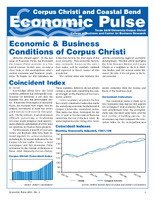
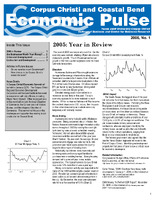
As you can see in the 2001 issue, Economic Pulse introduced itself as a practical tool. Its new coincident index combined four local indicators, such as nonfarm employment and the unemployment rate, into one measure of whether Corpus Christi’s economy was expanding or contracting. The same issue looked at trade links with Mexico and the effect of oil prices on the local economy. Compare its masthead with the 2013 issue. The College of Business is still the publisher, but it now shares the page with an “Office of Business & Economic Research” and an “EDA University Center.” The research had not changed much; its institutional home and its partners had.
The University Measures Itself
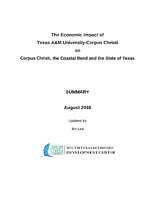
In May 2014, months before the Center was approved, Jim Lee of the College of Business and EDA University Center updated a report called The Economic Impact of Texas A&M University-Corpus Christi. It built on a 2003 study and later updates in 2006, 2009, 2011, and 2012.
The 2014 report described the university as “an economic engine.” It estimated a total benefit of about $259 million a year to the Coastal Bend, 5,344 full-time-equivalent jobs, and $7 of economic activity in Texas for every dollar of state funding. Students appear here mainly as spenders and future earners, not as learners.
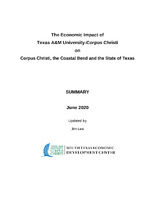
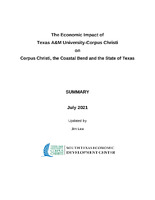
The updates continued through 2021. Together they show a public university learning to speak the language legislators and business leaders understand: impact figures. Ask yourself: what parts of a university’s value do these numbers leave out?
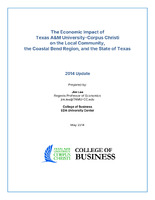
The 2014 report counts the university the way an economist counts a factory. It traces $181 million in direct spending: about $56 million from university operations and construction, $83 million from students, $39 million from employees, and $2.3 million from visitors. It adds that research brings more than $6 million a year in federal money to the region, and that TAMU-CC degrees raise the lifetime earnings of Coastal Bend residents by about $1.1 billion. Notice what the report measures and what it does not. Learning, civic life, and access for first-generation students appear only as future earnings. The later summaries, through 2021, repeat this format, which suggests it had become the university’s standard way of explaining its value.
2014: A Center Is Born
On September 3, 2014, the Board of Regents of the Texas A&M University System passed Minute Order 162-2014, which reads: “The South Texas Economic Development Center is hereby established as an organizational unit of Texas A&M University-Corpus Christi within the College of Business.” The next day, the Corpus Christi Caller-Times reported the news under the headline “A&M OKs economic development center” (Ramirez, 2014, as cited in Johnson, 2021). The university’s own history records the moment plainly: the College of Business “added the South Texas Economic Development Center in 2014,” a center that “produces regional monthly and annual economic reports” (Johnson, 2021). Jim Lee, Regents Professor of Economics and the author of Economic Pulse since 2001, led the Center until 2024.
The Center’s mission is to support “sustainable economic and community development in South Texas, particularly the Coastal Bend region.” It does so through research, sharing data with leaders and the public, and technical assistance to public and private decision makers. What had been a newsletter and a set of reports was now an institution with its own name.
One of the Center’s first reports, from October 2014, studied a proposed condensate plant in Ingleside. It was “commissioned by Cheniere Energy, Inc.” and carries a note that its findings “do not reflect the views of Texas A&M University-Corpus Christi.” That short disclaimer raises this exhibit’s central question: when a university is paid to analyze its region’s economy, is it acting as an analyst, an advocate, or both?
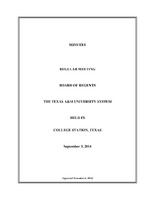
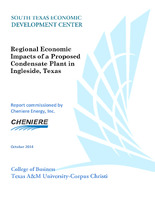
The Regents’ record is strikingly brief. In a meeting whose minutes run to more than 200 pages, the creation of the Center takes a single sentence on the consent agenda, listed between a congratulatory resolution and a list of faculty leaves. The brevity suggests that, by 2014, applied economic research no longer needed to be argued for; it had already become an ordinary part of what a regional university does. The Cheniere report shows what the Center did right away. Its acknowledgements page names the South Texas Economic Development Center as author, Jim Lee as principal investigator, and Cheniere Energy, Inc. as the funder. It then separates the university from the findings. That one page holds the whole tension of this exhibit: the university’s name and expertise give the report credibility, while the disclaimer tries to keep the university neutral.
Reading the Region Every Month
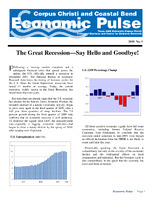
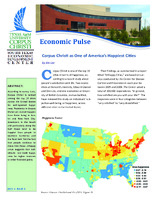
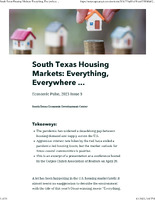
After 2014, Economic Pulse carried the STEDC name and appeared far more often, from about two issues a year in the 2000s to ten or more a year by 2016. Issues asked practical questions, such as what was driving job growth in the Coastal Bend during the Eagle Ford Shale oil boom (2014, Issue 6). By 2023 the newsletter compared Corpus Christi with other Texas metro areas, from the Rio Grande Valley to the state’s large cities.
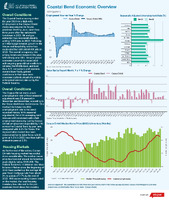
Beginning with data for late 2021, the Center also issued a short monthly Coastal Bend Economic Update. In one or two pages it reported jobs, unemployment by county, sales tax, and home prices across the region.
These publications were written for business owners, city officials, and journalists, not only for scholars. They show the university acting as a public source of economic information: a role that serves the community, and also makes the university a voice in local debates.
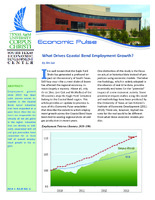
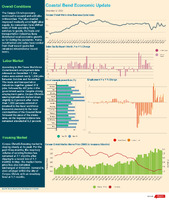
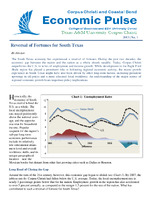
As you can see in the 2014 issue, the Center used its own data to answer questions the community was asking during the oil boom. Its analysis found that industries tied to oil and gas production accounted for at least half of the region’s job growth after 2010. The article also points out that it relied on actual employment data rather than model projections, a quiet claim to independence from other impact studies. The monthly update from December 2021 is shorter and plainer. It reports that the metro area added nearly 1,300 jobs in a month, that unemployment stood near 6 percent, and that the median home price held at $260,000. These are the numbers a city council member or a reporter would want.
The Center at Work: Impact Studies, 2014–2023
Most of the Center’s work came as impact studies: reports that estimate how many dollars and jobs a project, business, or event brings to the region. Many were requested and paid for by the organization being studied, such as an energy company, the visitors bureau, or a hospital system. Others looked at problems that numbers alone rarely capture, such as young people out of school and work, or fairness in public contracting. As you browse, notice who asked for each study and what question it was meant to answer.
Energy, Industry, and the Port
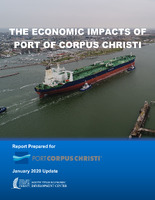
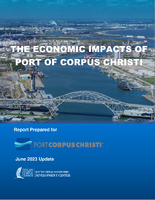
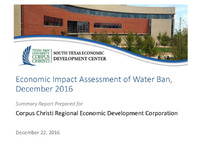
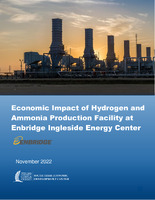
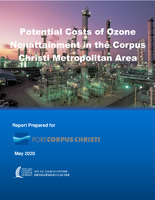
The Coastal Bend’s economy runs on oil, gas, petrochemicals, and the Port of Corpus Christi. The Center measured the regional value of new plants, port operations, and energy projects, and also the costs of an air-quality “nonattainment” designation and a citywide water ban.
Tourism, Sports, and Culture
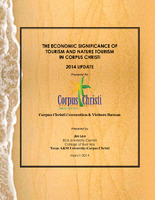
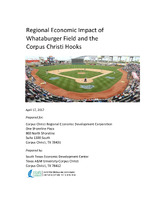
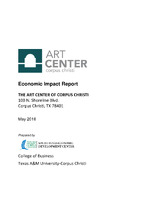
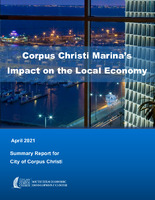
Universities do not usually count hotel stays and baseball tickets. These studies, for the visitors bureau, the Hooks baseball team, the marina, and the Art Center, show the university helping the city argue that leisure and culture pay off.
Health, Education, and Equity
A smaller set of studies turns economic tools toward social questions: hospital investment, school outcomes, disconnected youth, and fairness in the regional transit authority’s contracting. These reports keep alive the older idea of the university as a servant of opportunity, not only growth.
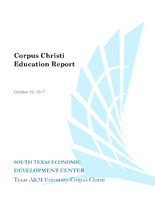
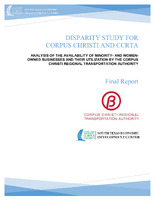
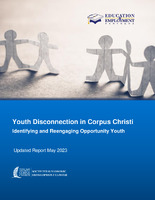
Look at the cover of each report and notice who asked for it. The 2014 tourism study was prepared for the Corpus Christi Convention & Visitors Bureau and still carries the “EDA University Center” label, months before the STEDC name existed. Later studies were done for the Port of Corpus Christi, energy companies, a hospital system, and a minor-league baseball team. Most of them answer one question: how much is this worth to the region? A few ask something different. The education reports, the transit disparity study, and the 2023 study of disconnected youth use the same economic tools to ask who is being left behind. Together, the three groups show a university serving both growth and opportunity, sometimes in the same year.
The Center Today
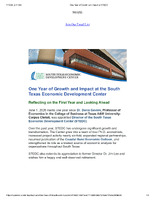
Jim Lee directed the South Texas Economic Development Center from 2014 to 2024. On June 1, 2025, economist Dr. Deniz Gevrek became its director. In its first year under new leadership, the Center grew from one economist to a team of four Ph.D. economists with more than 75 years of combined experience. Its project activity rose nearly six-fold, and it resumed its monthly Coastal Bend Economic Outlook, which reaches more than 600 stakeholders (STEDC, 2026).
The Center’s clients look much like those of the Lee years: seaports, school districts, city governments, economic-development groups, nonprofits, technology firms, and private industry. Its director’s commentary on Corpus Christi’s energy exports even reached a national audience on NPR’s Marketplace. The Center now also plans a dedicated office suite in the College of Business, a visiting economist position, and more opportunities for students to take part in its research.
That last change matters for this exhibit’s question. The Center’s mission still promises “data-driven analytics and technical assistance” to regional leaders, but its plans now also aim to involve more students in that work. More than fifty years after the public university opened its doors to place-bound students, its economic-development center is also becoming a classroom.
Reflection
In 1973, TAMU-CC’s promise to South Texas was a seat in a classroom. By 2014, it also included a research center that produces economic analysis for the region’s companies and governments. The change did not happen in a single moment. It grew through a business newsletter begun in 2001, a federal Economic Development Administration partnership, impact reports the university wrote about itself, a Regents’ vote, and, after 2024, a larger team that hopes to involve more students. Labaree (2017) argues that American universities survive by serving many constituencies at once, adding new functions when the market and the state reward them, and the STEDC fits that pattern. Seen through the lens of the neoliberal university, it also shows public value being redefined as economic return. Yet the Center’s studies of disconnected youth, schools, and fair contracting show that the older public-good mission did not disappear. What stayed the same is that the university still defines itself by what it owes South Texas; what changed is how that debt is measured. For today’s educational leaders, the question remains: when a university is paid to study the projects of its partners, how can it protect independent inquiry, and who decides which questions about the region get asked?
References
Board of Regents, The Texas A&M University System. (2014, September 3). Minutes, regular meeting of the Board of Regents (Minute Order 162-2014). https://assets.system.tamus.edu/files/bor/pdf/Minutes/Regular/2014/2014_09_03F.pdf
Johnson, A. (2021). The Island University: A history of Texas A&M University-Corpus Christi. Texas A&M University Libraries. https://odp.library.tamu.edu/tamucchistory/
Labaree, D. F. (2017). A perfect mess: The unlikely ascendancy of American higher education. University of Chicago Press.
Lee, J. (2001). Economic & business conditions of Corpus Christi. Economic Pulse, 2001(2). College of Business, Texas A&M University-Corpus Christi.
Lee, J. (2014, March). The economic significance of tourism and nature tourism in Corpus Christi: 2014 update. EDA University Center, College of Business, Texas A&M University-Corpus Christi.
Lee, J. (2014, May). The economic impact of Texas A&M University-Corpus Christi on the local community, the Coastal Bend region, and the State of Texas: 2014 update. EDA University Center, College of Business, Texas A&M University-Corpus Christi.
Lee, J. (2014, October). Regional economic impacts of a proposed condensate plant in Ingleside, Texas. South Texas Economic Development Center, Texas A&M University-Corpus Christi.
Ramirez, C. (2014, September 4). A&M OKs economic development center. Corpus Christi Caller-Times. (As cited in Johnson, 2021.)
South Texas Economic Development Center. (n.d.). Meet our STEDC team. Texas A&M University-Corpus Christi. https://tamucc.edu/business/centers-research/stedc/stedc-about.php
South Texas Economic Development Center. (n.d.). Mission and activities. Texas A&M University-Corpus Christi. https://www.tamucc.edu/business/centers-research/stedc/stedc-mission.php
South Texas Economic Development Center. (2026, June 1). One year of growth and impact at the South Texas Economic Development Center [Email newsletter]. Texas A&M University-Corpus Christi.
Texas A&M University-Corpus Christi. (n.d.). The university. In Texas A&M University-Corpus Christi catalog. https://catalog.tamucc.edu/general-information/university/
Texas A&M University-Corpus Christi. (n.d.). 75 years on the island. https://www.tamucc.edu/75th-anniversary/index.php